A 12-Point Car Background Test Before Approving a Template
Run twelve background-specific checks across color contrast, perspective, glass and export. Record failures before approving a preset for your team.
By HeyDreaming
Published by HeyDreaming, which supplies the tools described. Examples reuse dated internal QA on public-source images, not customer results. The worksheet is manual and does not add product functionality.
Before approving a fixed studio backdrop across an entire inventory gallery, evaluate the composite using a focused car background test checklist. Our separate 15-point image-quality checklist also covers source quality, condition evidence and final-file checks. This twelve-point test concentrates on the selected background and its interaction with the source. In HeyDreaming's self-serve workflow, four fixed backdrops are available: White sweep, Light grey, Dark grey, and Showroom soft. A fixed scene does not relight the car, and a rendered contact shadow does not guarantee an accurate cutout mask.
While our overview on white background car photos explains general studio cutout mechanics, this protocol provides twelve concrete pass/fail checks to evaluate vehicle edges, shadows, glass, perspective, and export integrity before rolling out a template.
The 12-Point Verification Workflow
Evaluating background replacement quality requires an orderly four-stage review:
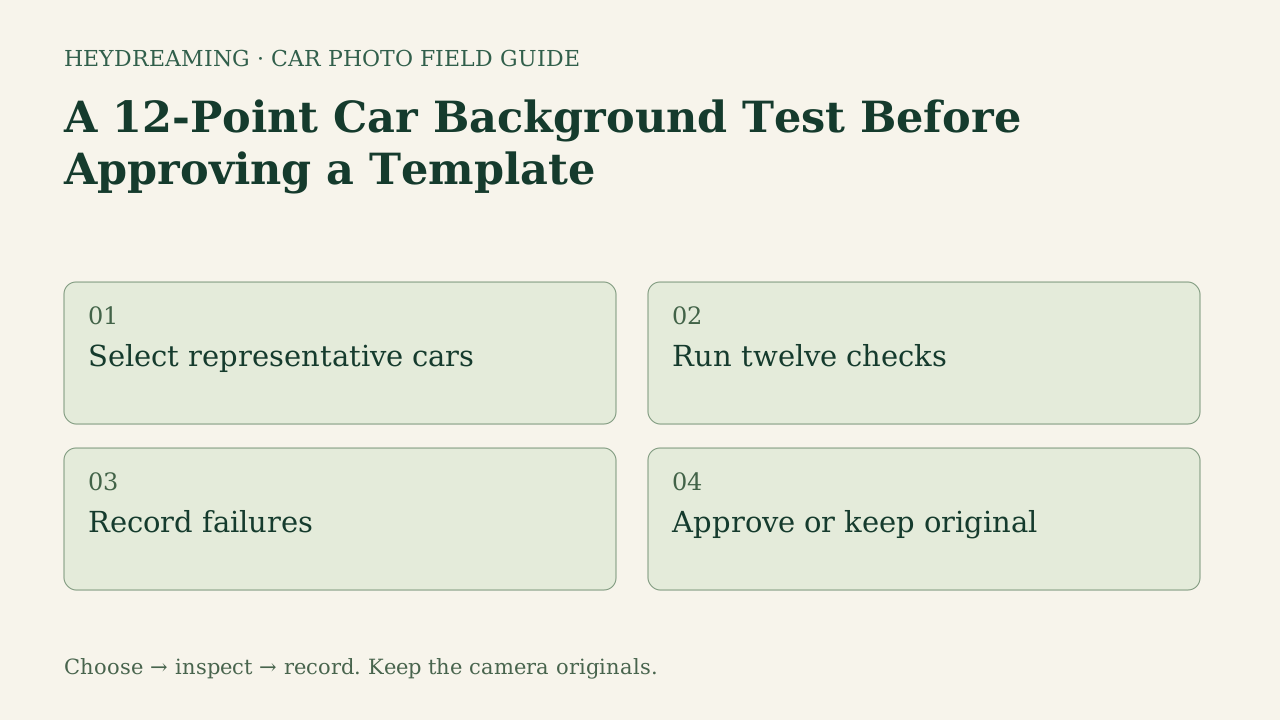
This diagram illustrates an explanatory review workflow, not a measured performance benchmark:
- Select representative cars: Choose test captures spanning light paint, dark paint, and distinct vehicle bodies.
- Run twelve checks: Systematically inspect each boundary and compositing checkpoint.
- Record failures: Document any clipped panels, edge halos, or floating tire artifacts.
- Approve or keep original: Record a decision for the inspected reference and photo role, or keep the camera capture. Continue inspecting new frames rather than approving an entire vehicle class from one sample.
The Twelve Pass/Fail Checks
Inspect an actual saved file at its intended thumbnail size and at 100%. The shown samples use 1920×1440, but check the mode and dimensions you selected. Record Pass, Fail or N/A for this image, with the source reference and next action.
| Check Stage | Inspection Zone | Pass Criteria | Action on Failure |
|---|---|---|---|
| 1. Vehicle-color contrast | Full silhouette | Clear separation from backdrop | Switch preset tone |
| 2. Roofline | Pillars & roof rails | Smooth, continuous contour | Check capture lighting |
| 3. Mirrors | Mirror housings | Housing outline intact | Re-evaluate source |
| 4. Tires | Rubber & tread edges | No clipped sidewalls | Keep lot capture |
| 5. Ground shadow | Tire contact patch | Plausible tire contact | Inspect source stance; reshoot if needed |
| 6. Glass view | Cabin windows | Retained photographed view is acceptable | Keep the source or recapture cleaner context |
| 7. Paint reflections | Doors & quarter panels | Natural exterior highlights | Avoid harsh lot glare |
| 8. Scene perspective | Stance & horizon | Car sits level on floor plane | Re-align camera pitch |
| 9. Vehicle scale | Frame margins | Selected canvas retains the required vehicle | Reframe the source; use an external crop only if appropriate |
| 10. Photo role | Gallery placement | Applied to exterior angles only | Keep cabin unedited |
| 11. Thumbnail view | Search feed sizing | Distinct silhouette at low res | Select higher contrast |
| 12. Saved export | Final file output | Correct dimensions & format | Re-export master file |
Put your car on a clean background
20 free AI photo edits a day. Copy your source vehicle onto a fixed background, then check the outline and plate cover. Sign in to start; no credit card needed.
Reference Verification on Acura and Ridgeline Samples
In internal QA tests on October 31, 2026, we processed public-domain reference vehicles through HeyDreaming's background workflow to evaluate boundary behavior across contrasting presets.
The figures below show the white 2010 Acura RDX and black 2012 Honda Ridgeline Sport evaluated on contrasting backdrops:
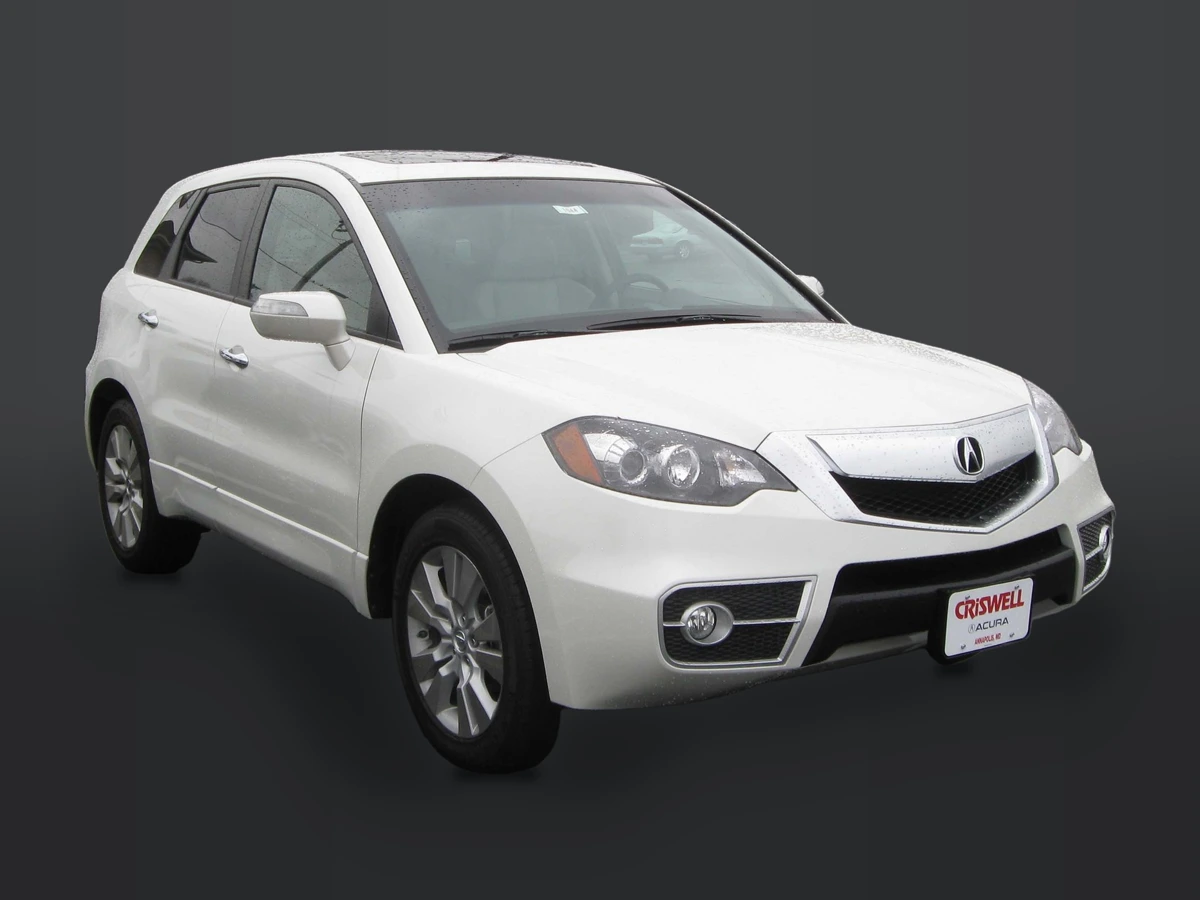
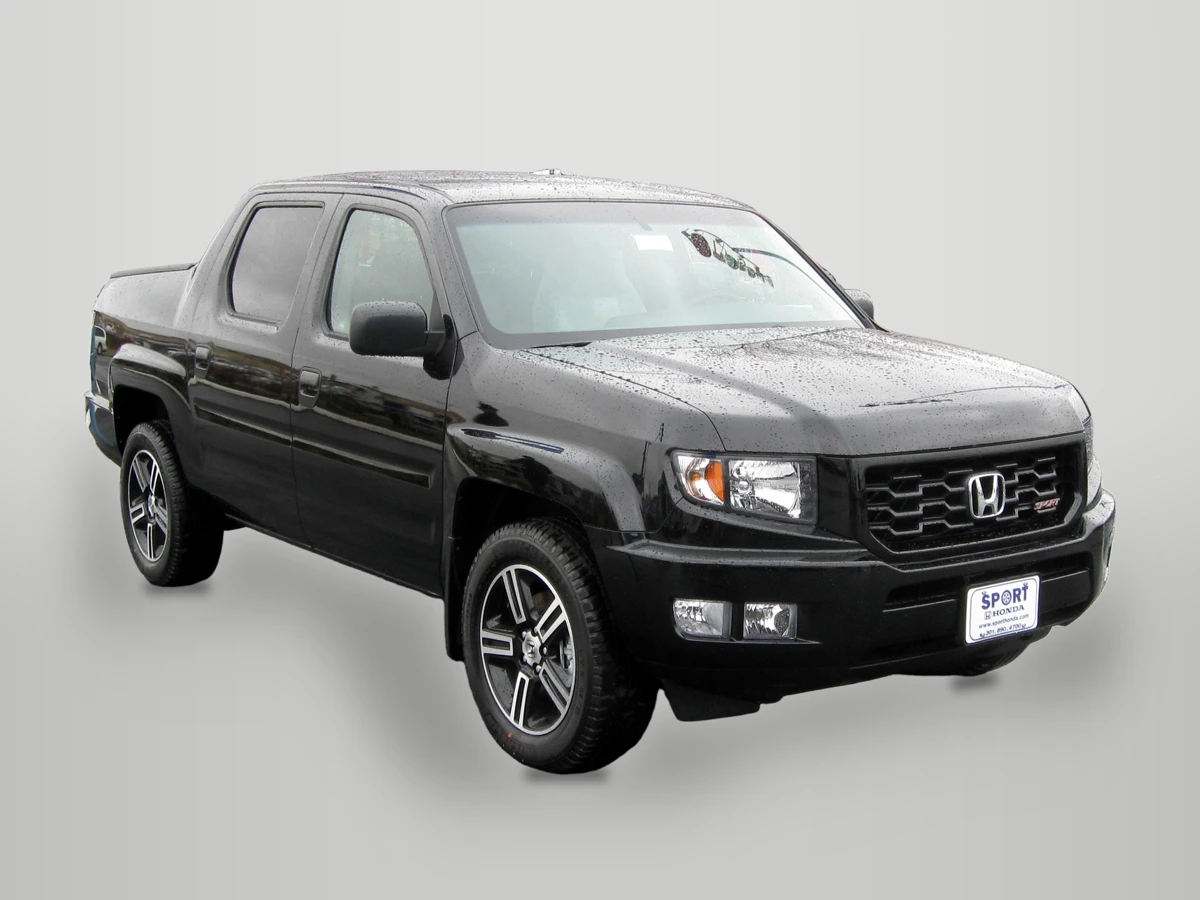
Photo credits: Acura RDX by IFCAR, Public domain, via Wikimedia Commons; Honda Ridgeline Sport by IFCAR, Public domain, via Wikimedia Commons. Modifications: source images re-encoded, vehicles extracted and composited onto HeyDreaming's presets with rendered floor shadows, scaled to standard export dimensions, and compressed to WebP for web delivery.
Why these figures matter for your test checklist:
- Upper Boundary Precision: On the white Acura RDX composited onto Dark grey, the high contrast immediately reveals whether the roofline, antenna mast, or side mirrors suffered ragged edges during extraction.
- Lower Edge Definition: On the black Ridgeline Sport composited onto Light grey, the lighter backdrop highlights whether tire tread patches and mud flaps remain sharp or look unnaturally clipped.
- Core Pixel Integrity: In our eight background worker jobs (evaluating both vehicles across all four fixed presets with corrections off), an eroded opaque vehicle core had zero differing pixels across lossless output masters. That match is across each car's four lossless masters, away from boundaries; it does not establish an accurate outline, physical paint calibration or JPEG/WebP equality.
For specific guidance on vehicle paint interactions, review our analysis of car backgrounds for white and black vehicles.
Downloadable 12-Point Checklist Worksheet
To record inspection results across your photography workflow, track decisions using our downloadable spreadsheet template:
Download the 12-point background checklist (CSV)
Use this manual spreadsheet to log quality reviews across all twelve checks: vehicle-color contrast, roofline, mirrors, tires, ground shadow, glass view, paint reflections, scene perspective, vehicle scale, photo role, thumbnail view, and saved export. For each vehicle stock number and file, staff record observed results, assign pass/fail decisions, document next actions, and sign off with a reviewer name. The worksheet is a manual audit aid that does not connect to DMS software or enforce application behavior.
Frequently Asked Questions
How does this 12-point checklist differ from a 15-point photography audit?
The 15-point image-quality checklist covers source focus/exposure, required views, vehicle condition, outlines and final files. This test asks a narrower question: does the selected background work with this source, including its edges, contact shadow, retained glass view and canvas?
What should staff do if a car fails the tire or roofline check?
If tires or rooflines show jagged clipping or rough halos, first inspect whether the source photo had high-contrast background obstacles like fences or grass. A different preset can expose or hide a halo but does not repair the mask. Consider an available redo, retain the source, or reshoot when evidence is missing; inspect the resulting file again.
Does a natural contact shadow guarantee an accurate cutout mask?
No. HeyDreaming renders a soft floor shadow under the chassis and wheels to anchor the vehicle, but that shadow does not repair or certify lower-panel and tire edges. Inspect the outline independently.
Immediate Next Action
Select one owned exterior photo from your current inventory and process it through HeyDreaming's AI car photo editor to apply these twelve checks, then repeat the saved-file inspection on each frame you intend to publish.
Put your car on a clean background
20 free AI photo edits a day. Copy your source vehicle onto a fixed background, then check the outline and plate cover. Sign in to start; no credit card needed.
Keep exploring