Car Photo Editing Time: A Transparent 12-Job Internal Test
Read the method, output checks and limits of a twelve-job internal timing test. Download the observations; capture and human-review time were not measured.
By HeyDreaming
Published by HeyDreaming, which supplies the tools described. Examples reuse dated internal QA on public-source images, not customer results. The worksheet is manual and does not add product functionality.
Evaluating turnaround claims for automotive merchandising software requires inspectable measurement definitions and recorded observations. Conducting an empirical car photo editing time study demands separating raw automated API processing from human dealership tasks like lot staging, image sorting, visual quality control, and physical reshoots. When marketing materials claim vehicle photos can be edited in seconds, dealerships must understand exactly which phases of the pipeline were measured and which operational steps remain unmeasured human labor.
For broader analysis on operational economics and handoff friction, review our core guide on car photo editing cost, our breakdown of car photo workflow bottlenecks, and our vetting framework in the car photography quote checklist.
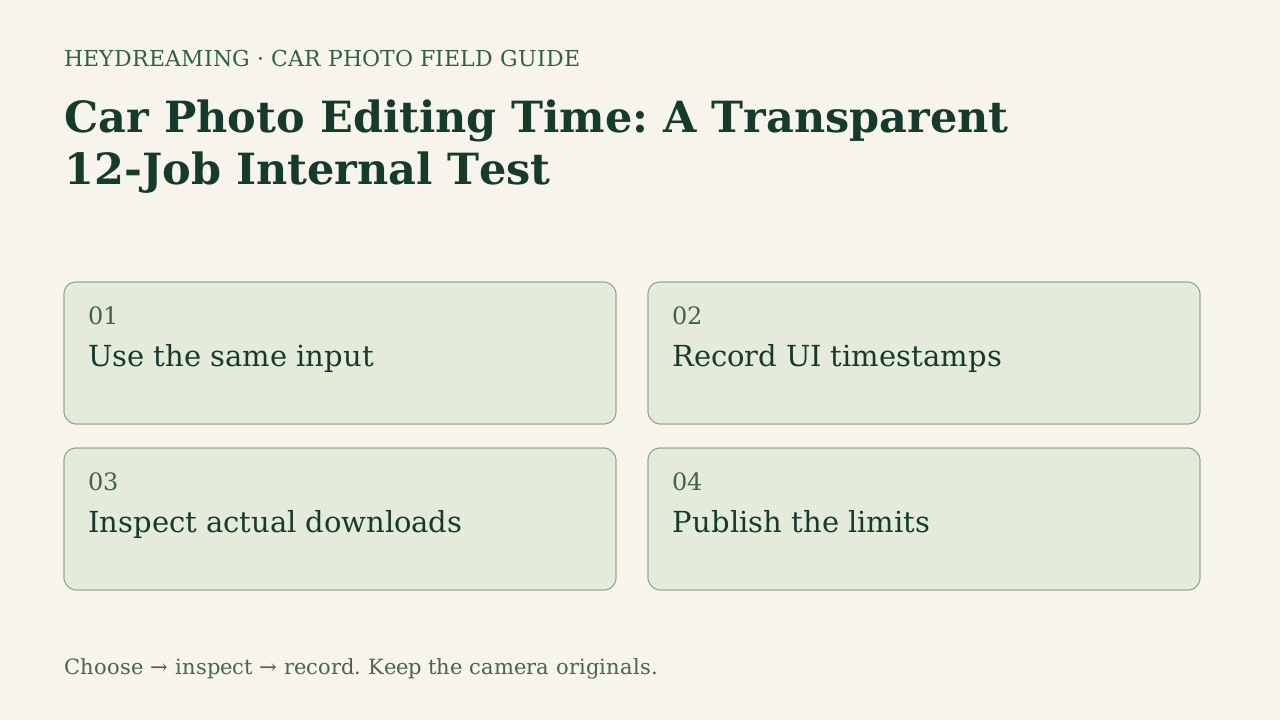
Open the full time study workflow diagram (SVG)
Note: The diagram above is an explanatory workflow mapping operational phases, not a measured statistical chart.
The Dated 12-Job Internal Test Methodology
The snapshot is dated October 31, 2026 in the America/Los_Angeles timezone. HeyDreaming recorded twelve actual UI-created jobs in one configured environment. This was not a comparison under controlled network load or a physical-dealership test.
The twelve jobs comprised two distinct test groups:
- Eight background replacement jobs: Four backdrop presets (White sweep, Light grey, Dark grey, and Showroom soft) evaluated across two real public-domain vehicles: an outdoor white 2010 Acura RDX and an outdoor black 2012 Honda Ridgeline Sport.
- Four correction jobs: Evaluated on an intentionally degraded test fixture to record execution variance when color adjustments and leveling algorithms are applied.
Across all twelve observed jobs, the measured submit-to-observed-completion time ranged between 5.588 seconds and 7.686 seconds. This is the combined submit-to-observed-terminal window, including network, queue, worker and polling effects. The component durations and GPU compute were not isolated.
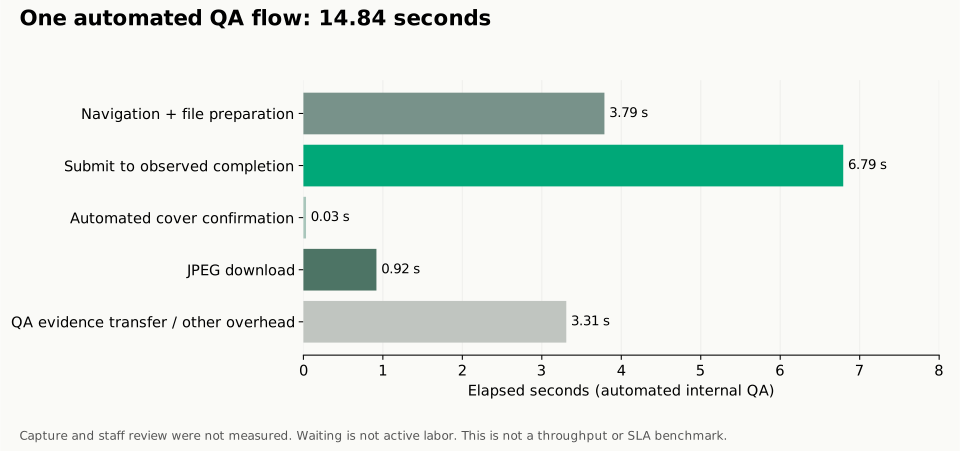
A timing chart represents an automated script, not staff labor. This recorded benchmark captures an end-to-end automated QA script run, not human dealership throughput.
First-Case Stage Breakdown: 14.841-Second Automated Run
The first recorded test run—processing the white 2010 Acura RDX onto the White sweep preset—completed its full automated script execution in 14.841 seconds. While marketing claims might simplify this to "under 15 seconds," auditing the stage breakdown shows how time is actually allocated:
- Page and file preparation (3.788s): Page navigation and file preparation as grouped in the script; individual substeps were not separately timed.
- Submit-to-observed-terminal (6.793s): Network upload, worker queue allocation, background separation, backdrop composition, and polling response.
- Scripted cover confirmation (0.033s): A scripted UI cover-confirmation interaction.
- JPEG download (0.919s): Fetching the completed 1920x1440 composite image back to local storage.
- QA transfer and logging (3.308s): QA evidence transfer and other overhead, not a measured normal dealership handoff.
The 0.033-second interaction was not a person reviewing the picture. Capture, staff inspection and reshoot time were unmeasured, not zero. This run supplies no typical human-review duration.
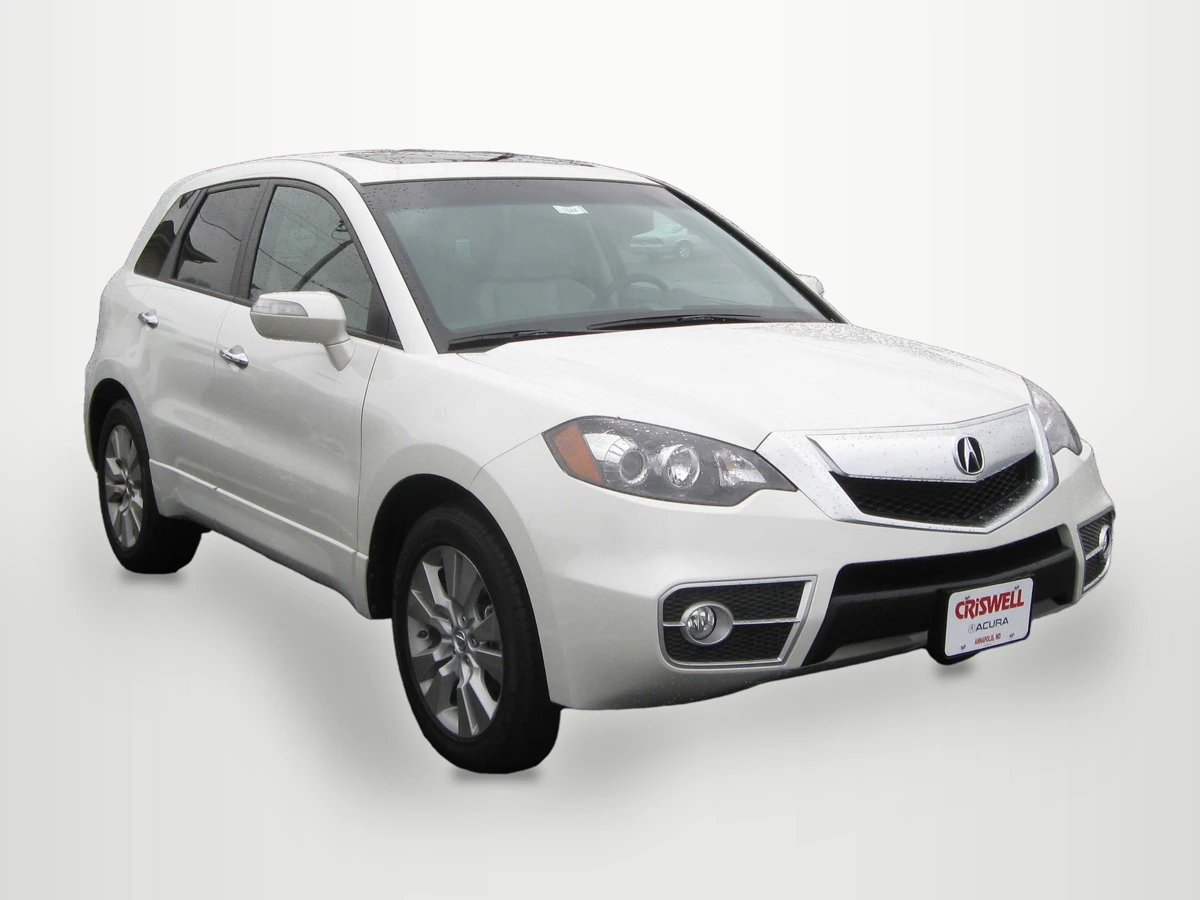
Input photo: 2010 Acura RDX by IFCAR, Public domain. The supplied vehicle was composited onto White sweep, scaled to 1920×1440 and compressed as a WebP preview of the actual saved output.

WebP previews are compressed versions of actual downloads. This preview illustrates the output asset generated in the 14.841-second benchmark run (1920x1440 JPEG / lossless master), showing the White sweep replacement composited around the vehicle body while original views and reflections remain visible through the windows.
Correction Fixture Disclosure and Results
Before evaluating the four correction jobs, it is critical to disclose that the test asset was deliberately and artificially degraded. Using a public-domain 2011 Mazda3 photo by IFCAR, the image RGB values were multiplied by [0.90, 1.00, 1.12], rolled 3 degrees counter-clockwise, placed on an expanded black canvas, and saved at JPEG 95 before browser upload re-encoding. This fixture does not represent a naturally defective dealer photo, camera calibration benchmark, or independent leveling proof; it was engineered specifically to ensure color gain and rotation algorithms were measurably exercised.

The four paths were default, color-only gains [1.1216,1.0059,0.8975], level-only 2.77° and both. Comparing default with color-only on the same prepared input and mask, 960,593 of 986,068 conservative core pixels differed. This shows the selected global correction changed values, not physical paint accuracy. Total submit-to-terminal times remained within the 5.588s to 7.686s bracket.
Put your car on a clean background
20 free AI photo edits a day. Copy your source vehicle onto a fixed background, then check the outline and plate cover. Sign in to start; no credit card needed.
Output Dimensions, Quota Costs, and Pipeline Constraints
Understanding the time study requires reviewing the technical specifications and quota consumption associated with each job:
| Observed setting | Result in this suite | Boundary |
|---|---|---|
| Actual downloads | Twelve 1920×1440 JPEGs, with corresponding lossless PNG masters | Other output modes were not the timing comparison |
| Background cases | Two source cars × four fixed presets, corrections off | These eight cases support the per-source across-preset comparison |
| Correction cases | Four paths on one deliberately modified Mazda input | Not natural customer defects or paint calibration |
| Allowance | Twelve daily photo edits charged | General credits unchanged; no new purchase |
| Human work | Unmeasured | Do not infer wages, accepted-car throughput or a service SLA |
All raw timing data points from this QA run can be inspected in the internal timing example CSV.
Standardized Time Study Tracking Worksheet
To evaluate your own editing workflow, use our downloadable manual time study template:
Download the car photo editing time study worksheet (CSV)
The worksheet contains twelve predefined rows corresponding to our internal test cases, covering the four backdrops across white and black vehicles as well as correction scenarios. Blank columns include source_ready_ms, submit_to_observed_terminal_ms, scripted_confirmation_ms, download_ms, total_script_ms, staff_minutes, and measurement_scope. The new worksheet pre-fills case labels but leaves measurements blank; the separate internal-example CSV contains the recorded observations. Use explicit start/end events and units for your own run. A single network request is not the duration of an asynchronous job; record your method and do not claim millisecond precision from a coarse manual clock. Because this is a manual tracking aid, it does not connect to dealership management systems or automatically import camera timestamps.
Testing Limitations and Scope Boundaries
When reviewing this time study data, several technical boundaries must be observed:
- Unmeasured labor stages: The internal QA test did not measure physical lot capture, car porter staging, manual cropping, staff visual inspection, reshoot logistics, or dealer management system ingestion. These stages remain unmeasured, not zero.
- No production SLA: The 5.588s–7.686s processing window reflects specific test conditions on October 31, 2026. Network latency, dealership Wi-Fi throttling, and server load will introduce variance.
- Core pixel consistency: Across the eight background jobs, the vehicle core pixels remained identical (0 different pixels) across the four presets for each car. A separate mask comparison also matched for each source. Core-pixel equality alone does not prove mask shape. Neither observation establishes correct outlines, glass cleanup, physical paint calibration or compressed-file equality.
- No sales velocity claims: This run did not measure inventory turns, inquiries, buyers or sales; it supplies no correlation or causal estimate for those outcomes.
Frequently Asked Questions
Does the 14.8-second script time include human photo inspection?
No. The test was executed by an automated test script. The 0.033-second step was a scripted confirmation interaction. No human visual-review time was measured, and this dataset gives no typical minutes-per-car value.
What allowance cost did these twelve jobs actually show?
These twelve UI-created single-photo jobs used twelve daily photo edits. General credits did not change and no new purchase occurred. Vehicles' at-most-two-redos-per-frame budget is a separate path; do not generalize every redo or free standalone plate edit into a new daily charge.
Can automated time studies predict total dealership turnaround?
No. No business turnaround fraction was measured. Capture, human review, reshoots and destination publication remain unknown here. Record those stages in your actual operation before identifying a constraint or planning a delivery commitment.
Immediate Next Step
To measure your dealership's actual round-trip processing time on your local network, run a single exterior vehicle photo through the AI car photo editor. Track the elapsed seconds from image submission to completed JPEG download to establish an empirical baseline before scaling to full inventory batches.
Put your car on a clean background
20 free AI photo edits a day. Copy your source vehicle onto a fixed background, then check the outline and plate cover. Sign in to start; no credit card needed.
Keep exploring