In-House vs Outsourced Car Photo Editing: Assign the Work
Assign capture, first QC, revisions and final dealer approval before choosing in-house or outsourced car-photo editing. Includes a responsibility worksheet.
By HeyDreaming · Updated
Published by HeyDreaming, which supplies the tools described. Examples reuse dated internal QA on public-source images, not customer results. The worksheet is manual and does not add product functionality.
Use an in-house vs outsourced car photo editing decision to assign work, not to remove review by assumption. Agree who captures, prepares, processes, performs first QC, checks condition, handles revisions and publishes. A provider can compare supplied source photos within the agreed scope, but a first technical check does not by itself establish the vehicle's actual condition or replace your named final approver.
While our parent guide on car photo editing cost outlines overall budgeting, this guide allocates tasks across seven operational stages—capture, preparation, processing, first QC, condition approval, revision, and publishing—comparing managed service packages with self-serve software.
The Handoff and Responsibility Workflow
Managing photography responsibilities requires an orderly four-stage division of labor:
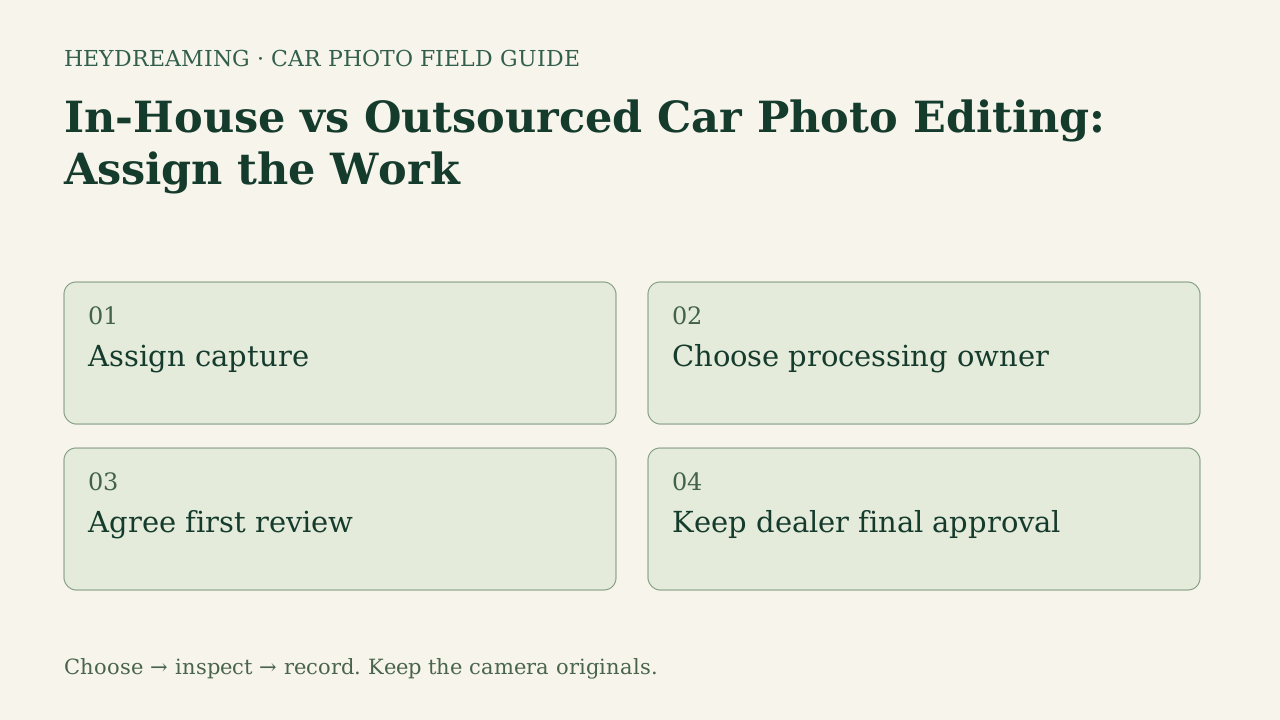
This diagram illustrates an explanatory review workflow, not a measured performance benchmark:
- Assign capture: Establish who handles physical staging, lot porters, and raw camera capture.
- Choose processing owner: Decide whether internal staff run automated self-serve tools or hand off files to a managed editing package.
- Agree first review: Define technical checks conducted by the processing owner (mask clipping, edge halos, floor shadow grounding).
- Keep dealer final approval: Retain final dealer sign-off for vehicle condition disclosures and listing accuracy.
Comparing Managed Packages with Self-Serve Capacity
When choosing who handles background post-processing, compare operational capacity against internal staffing resources:
Managed Editing Service Packages
For external execution, ask the provider to specify vehicle and photo limits, who selects backgrounds, who performs first review, revision rounds and the delivery window. Keep capture and final dealer sign-off assigned explicitly. HeyDreaming supplies self-serve software; your operator processes, reviews and exports the photos.
Internal Self-Serve Software Capacity
For dealerships keeping editing in-house, HeyDreaming's self-serve platform provides tier allowances: Free accounts receive 20 daily edits, while Pro ($29/month) and Max ($99/month) tiers provide 100 daily edits. Note that arithmetic allowances (such as 100 edits divided by 20 photos per car) do not guarantee 5 accepted vehicles per day due to retries, discards, and re-edits. Vehicles supports up to 50 photos per car. Staff select settings and inspect outputs; unattended processing time is not automatically active staff labor.
For calculating the cost of retries and discarded images, see cost of car photo rework, and identify operational delays in car photo workflow bottlenecks.
Evidence Inspection: Technical Compositing vs Dealer Condition
Reviewing real test samples clarifies where software stops and dealership inspection begins. In internal QA tests on October 31, 2026, we processed public-domain reference vehicles through HeyDreaming's background workflow.
The figures below show a white 2010 Acura RDX in its prepared upload and composited onto a White sweep:
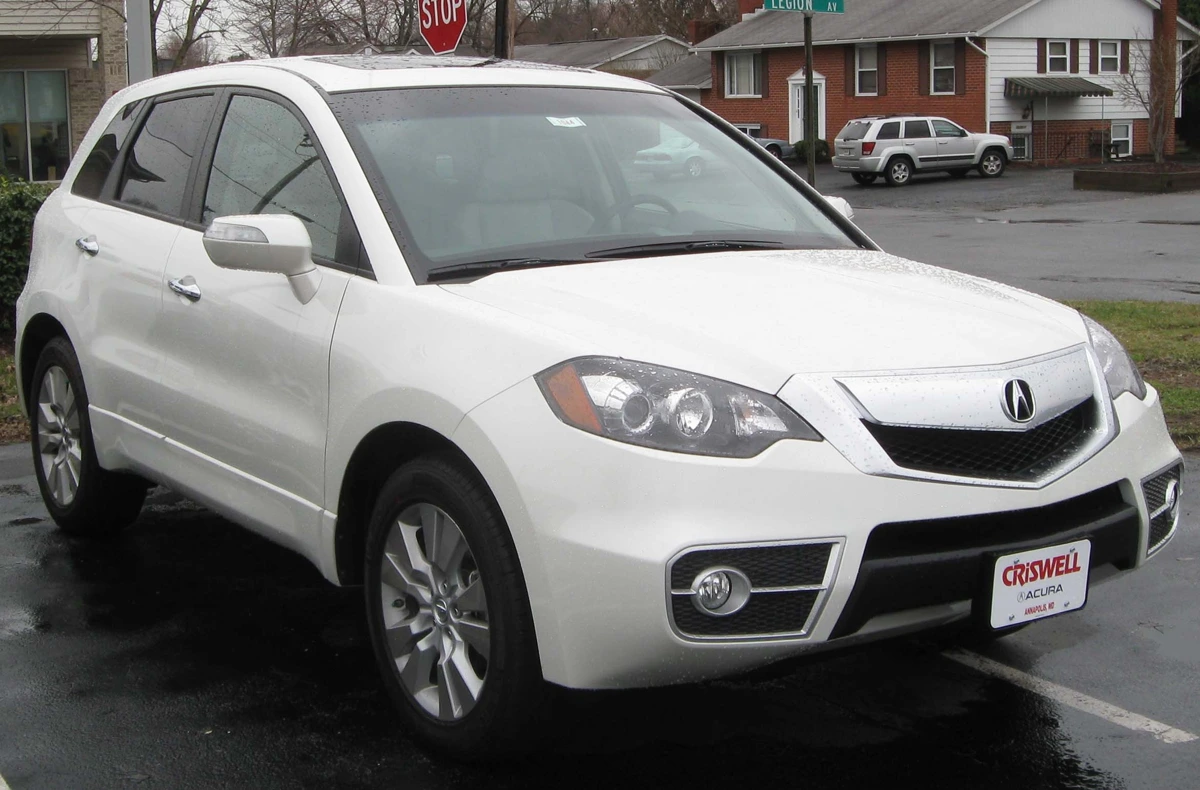
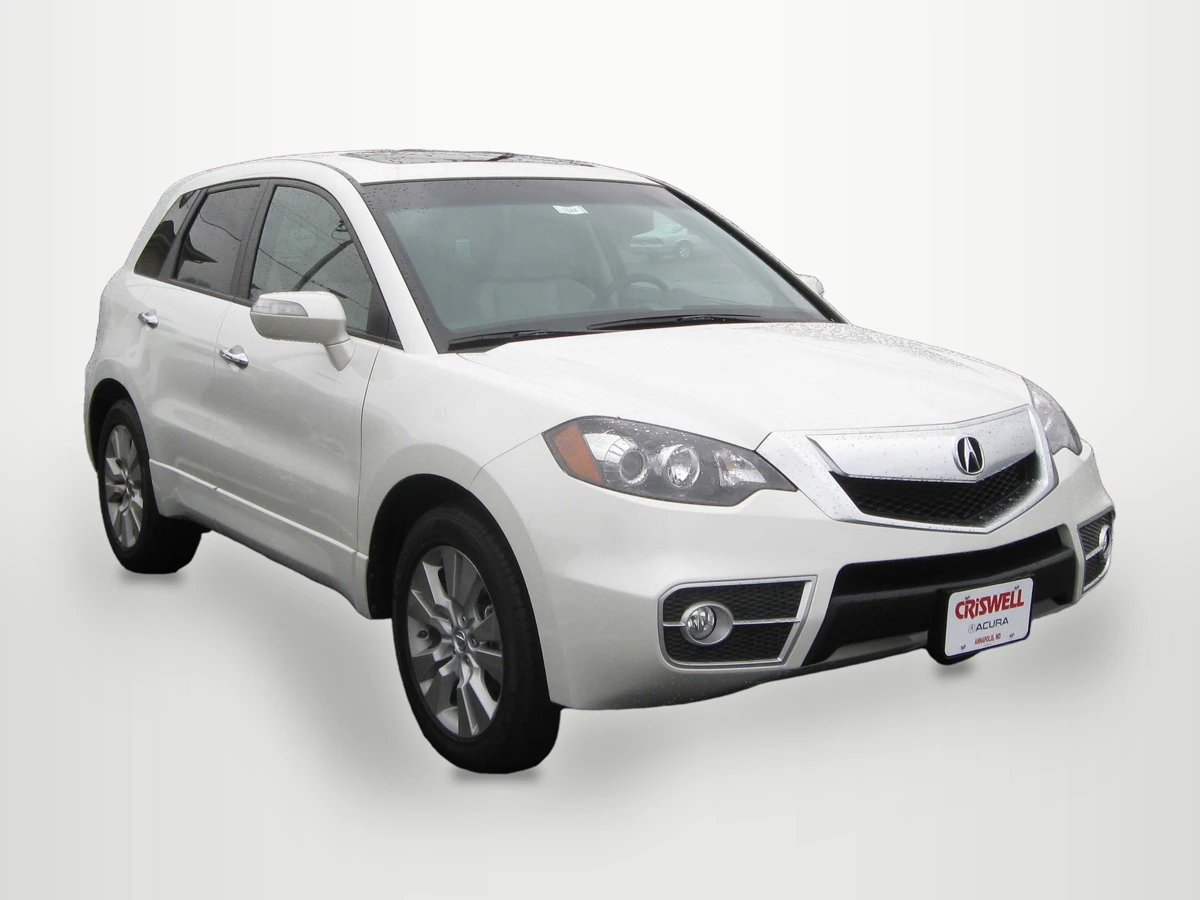
Photo credit: IFCAR, Public domain, via Wikimedia Commons. Modifications: source image re-encoded, vehicle extracted and composited onto HeyDreaming White sweep preset with rendered floor shadow, scaled to standard export dimensions, and compressed to WebP for web delivery.
Why these figures matter for task allocation:
- Separating Technical QC from Condition Approval: A first QC aims to check the agreed technical requirements and can still miss a defect. Compare visible marks against the supplied source, and assign a final approver who can resolve condition questions using the vehicle and its records. A photo cannot measure tread depth or prove mechanical condition.
- Glass Realities: Photographed outdoor views remain through cabin glass rather than being cleared or inpainted. Prepared/scaled exports are not promised byte-identical to the camera file.
- Pixel Core Integrity: Across our eight background worker jobs (two vehicles across four fixed presets, corrections off), an eroded opaque vehicle core had zero differing pixels across lossless output masters. That is a per-vehicle comparison across its four lossless masters, away from boundaries; it does not certify outline correctness, physical paint calibration or equality of JPEG/WebP previews.
Put your car on a clean background
20 free AI photo edits a day. Copy your source vehicle onto a fixed background, then check the outline and plate cover. Sign in to start; no credit card needed.
Operational Responsibility Matrix
| Stage | If editing stays in-house | If editing is handed off | Final responsibility to assign |
|---|---|---|---|
| 1. Capture | Name the staff member or separately hired photographer | Source photos still come from you or a separate capture agreement | Who checks the required shots? |
| 2. Preparation | Record stock, source files and desired outputs | Agree intake format, identifiers and permissions | Who resolves a wrong-car or missing-file problem? |
| 3. Processing | Staff select the self-serve choices | Provider follows the agreed scope | Who records allowed changes? |
| 4. First QC | Inspect saved outlines, glass and covers | Specify what the provider reviews | Who handles a failed technical check? |
| 5. Condition approval | Compare source, actual vehicle evidence and output | Provider can assist within scope; final approval is not automatic | Name the final inventory approver |
| 6. Revision | Available redo, original or reshoot; external crop if needed | Agree the included round and any further work | Who accepts the corrected file? |
| 7. Publishing | Hand off or upload files manually in this flow | Provider delivers the agreed files | Who checks the destination preview and publishes? |
Downloadable Responsibility Allocation Worksheet
To document team roles and handoff criteria across your imaging pipeline, use our downloadable template:
Download the in-house vs outsourced responsibility worksheet (CSV)
Use this manual spreadsheet to allocate accountability across seven critical pipeline stages: capture, preparation, processing, first QC, condition approval, revision, and publishing. For each task, staff assign the in-house owner, outsourced owner, final approver, revision owner, handoff evidence standard, and operational notes. The worksheet is a manual planning aid that does not connect to DMS software or enforce application behavior.
Frequently Asked Questions
Can a dealership rely on an outsourced vendor's QC for final approval?
Do not treat an unspecified first QC as final condition approval. Agree what the provider checks, compare outputs with the supplied source and name the final inventory approver. A provider may help inspect visible changes, but actual condition and configuration questions need the appropriate vehicle evidence.
How do daily software allowances affect in-house capacity?
Self-serve plans provide daily edit caps (such as 100 photo edits per day on Pro or Max). Accepted sets depend on charged photo count, retained/refunded photos, the redo path and final inspection. The result is not necessarily a fixed number of cars above or below simple division. Standalone plate-box edits use a different free flow. Track actual charges and accepted sets separately.
What handoff evidence is required when transferring files to an outsourced editor?
Dealers should provide untouched original camera captures, vehicle stock numbers, and explicit background preset choices (e.g., White sweep or Light grey). Always store unedited camera originals locally before uploading batches for external processing.
Immediate Next Action
Select one owned exterior photo from your lot and test it in HeyDreaming's AI car photo editor to create an acceptance reference, then allocate all seven tasks in the worksheet. If you work with an outside provider, confirm revision ownership and the delivery window with them; one sample does not measure your staff or a provider's turnaround.
Put your car on a clean background
20 free AI photo edits a day. Copy your source vehicle onto a fixed background, then check the outline and plate cover. Sign in to start; no credit card needed.
Keep exploring